The literary legends who may not be buried where you think.
When you visit Père Lachaise Cemetery in Paris, you’ll find more than just peace and quiet among the trees. You’ll find stories—some told in stone, some still debated centuries later. Two of the cemetery’s most visited tombs belong to Molière and Jean de La Fontaine, pillars of French literature. But while their names are engraved in marble, the mystery of whether their remains truly lie beneath has never been resolved.

If you’re exploring the cemetery, make time to stop by Molière’s tomb, located in Division 25, near the Avenue de la Chapelle. His grave is solemn and classical, a fitting tribute to a playwright who helped define French theater. It often draws visitors who leave pens or small notes in honor of the man who gave us Tartuffe and The Misanthrope.

Just steps away, in the same Division 25, you’ll find La Fontaine’s tomb. It’s marked by sculptural elements referencing his fables, including carved animals that pay homage to his storytelling legacy. Despite the uncertainty of his actual burial, this grave has become a symbolic place of remembrance for admirers of his sharp wit and poetic insight.
So how did two men who died over a century before Père Lachaise even existed end up there? And are they really buried in these iconic spots? The answer is more complicated than it seems.
Père Lachaise and the Prestige Problem

Père Lachaise Cemetery opened in 1804, designed to be both elegant and modern. Inspired by English garden cemeteries, it offered green spaces, winding paths, and a peaceful alternative to the crowded churchyards of central Paris. But it had a big issue. No one wanted to be buried there.
Located far from the city center in a working-class district, the cemetery was seen as remote and overpriced. Wealthy Parisians avoided it, and in its first ten years, only around 2,000 people were buried there.
The Strategy: Bury the Famous
By 1817, the city needed to change public opinion. So officials made a bold move. They arranged for the transfer of the supposed remains of Molière and La Fontaine to Père Lachaise. These two literary icons were already national treasures, and placing them there was a calculated decision to make the cemetery more desirable.
It worked. Within a decade, the number of burials had skyrocketed. People wanted to be buried near greatness. Today, Père Lachaise has more than 70,000 graves and draws over three million visitors a year. But were those really the bones of Molière and La Fontaine?
Molière, the Outcast Performer

Jean-Baptiste Poquelin, known as Molière, was France’s most celebrated playwright. But in the 1600s, actors were viewed with suspicion by the Catholic Church. They were automatically excommunicated and denied a Christian burial unless they renounced their profession on their deathbed.
Molière died in 1673 after collapsing during a performance of The Imaginary Invalid. According to reports, he asked for the last rites but was refused by two priests. A third arrived too late.
Because of his status at court and his popularity, the Church faced pressure. A compromise was found. Molière was buried quietly at night in the Saint-Joseph cemetery. No ceremony, no fanfare. On the burial register, he was listed under his official title at court, “Jean-Baptiste Poquelin, tapissier du roi”, meaning royal upholsterer.
The grave was unmarked, and over time, the cemetery was cleared. His exact burial site vanished along with it.
La Fontaine, the Late Convert

Jean de La Fontaine, author of The Fables, had a smoother relationship with the Church. Known for his sharp wit and sometimes risqué writings, he had a change of heart in his later years. He renounced his earlier works, took part in religious rituals, and declared he would only write pious texts from then on, though he never fully followed through.
He died in 1695 and was buried at the Holy Innocents’ Cemetery, close to his home and his parish church, Saint-Eustache. His burial was recorded and accepted. But confusion came later.
A few decades after his death, a cleric named Abbé d’Olivet mistakenly wrote that La Fontaine had been buried near Molière in the Saint-Joseph cemetery. That error set off a chain of events that would alter their posthumous histories.
Revolution and Relocation
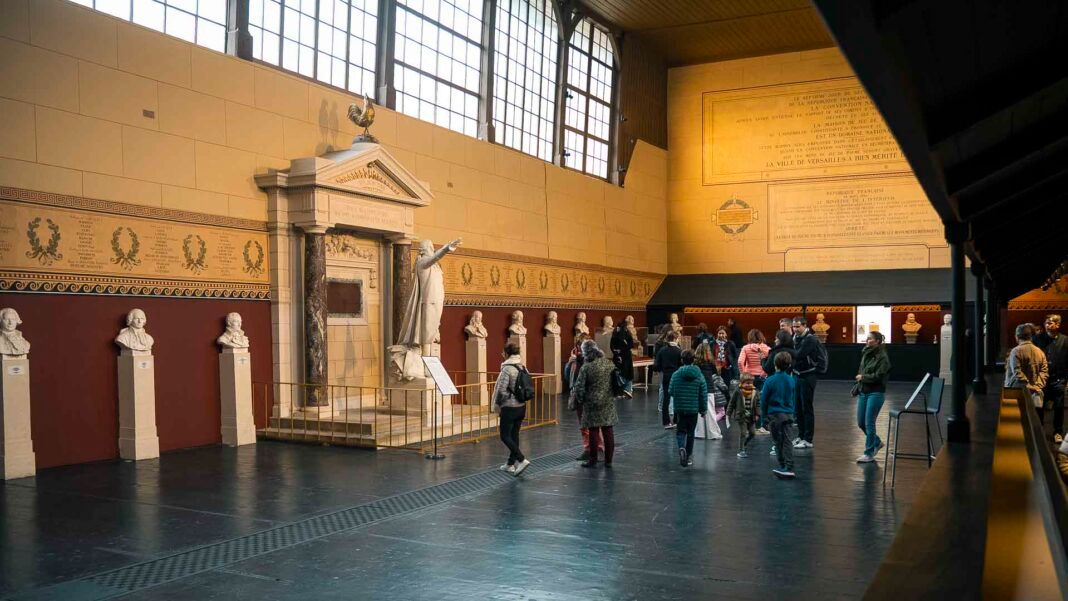
In 1792, during the French Revolution, France started celebrating its great figures with new intensity. The state wanted to honor national icons, and officials decided to exhume Molière and La Fontaine to display their remains at the Musée des Monuments Français.
The problem was no one could say for sure where their bodies were. But based on d’Olivet’s incorrect note, they exhumed what they believed were the remains of both men and placed them in the museum.
When the museum closed in 1816, the opportunity arose to transfer these high-profile remains to Père Lachaise, which badly needed star power. That is how the tombs of Molière and La Fontaine ended up in the cemetery.
The Historical Doubts

Modern historians are nearly certain that La Fontaine’s body never left the Holy Innocents’ Cemetery. That site was eventually cleared, and most of its bones were transferred anonymously to the Paris Catacombs. There is no credible evidence La Fontaine was ever buried near Molière.
As for Molière, things are less clear. Some evidence suggests he may have been buried in two locations within Saint-Joseph, one public and one hidden. One theory holds that his body was quietly moved after the first burial to a section for unbaptized infants and suicides, places usually considered spiritually condemned. When Saint-Joseph was cleared, his remains likely ended up in the Catacombs as well.
A Myth Built to Last

So are Molière and La Fontaine really buried at Père Lachaise? Probably not. But their symbolic tombs gave the cemetery exactly what it needed, cultural weight and historical gravity. And in a way, this is fitting. Both men built careers on storytelling and irony, and even their posthumous fame has a twist.
The tombs at Père Lachaise might be empty, but the legacy is full. The city turned death into a monument, used myth to attract the living, and wrote its own script about who lies where. If nothing else, it proves that memory, like literature, often outlasts the facts.
Want to explore Père Lachaise yourself?
Guided tours are a great way to uncover the hidden stories behind the famous names and forgotten corners of the cemetery. Here are some top-rated tours that take you through the history, legends, and secrets of Père Lachaise.