Versailles, the epitome of opulence and grandeur, has witnessed countless tales of intrigue, but few scandals have reverberated through history as powerfully as the Affair of the Diamond Necklace. This explosive saga, which unfolded between 1784 and 1785, became a catalyst for the downfall of the French monarchy, forever tarnishing the reputation of Queen Marie Antoinette and fueling the discontent that led to the French Revolution.
A Necklace Fit for a Mistress


The story begins in 1772 with Louis XV, who commissioned an extraordinary diamond necklace for his mistress, Madame du Barry. Crafted by Parisian jewelers Charles Auguste Boehmer and Paul Bassenge, the piece was designed to be the most magnificent in all of Europe. The jewelers, formerly suppliers to the Polish court, were renowned artisans whose clients included foreign sovereigns. Confident of their success, they personally financed the necklace, amassing significant debt in the process.


The project took years, as they meticulously gathered 674 diamonds of exceptional purity, totaling 2,840 carats. The result was a masterpiece—a cascading work of diamonds and pearls in an elaborate “en esclavage” style, featuring 17 large diamonds at its center, surrounded by intricate garlands and pendants. It was valued at an astronomical 1.6 million livres (approximately €27.5 million in today’s currency).

However, Louis XV died of smallpox in 1774, leaving the extravagant piece unpaid for. His successor, Louis XVI, banished Madame du Barry from court, leaving the jewelers desperate to find a buyer for their costly creation.
Marie Antoinette’s Rejection


When the reign of Louis XVI began in 1774, France’s economic situation was disastrous. The monarchy faced crippling debt, with expenditures far exceeding revenue. The treasury was 335 million livres short, and the country teetered on the brink of bankruptcy.
The jewelers, still hoping for a royal buyer, presented the necklace to Marie Antoinette, knowing she had a well-known passion for gems. However, she flatly refused.
According to Madame Campan, her trusted lady-in-waiting, Marie Antoinette remarked that the funds would be better spent on building a warship, as France had just allied itself with the American insurgents. Additionally, the necklace’s style, reminiscent of the previous reign, did not appeal to her. She even compared it to a “horse’s harness”.
Despite her repeated refusals, Louis XVI considered purchasing it as a gift after the birth of their son Louis Joseph in 1781. However, France’s naval defeat at Les Saintes further drained the kingdom’s finances, and the sale was abandoned once more.
The jewelers, now on the verge of financial collapse, attempted to sell the necklace abroad, offering it to Spain, England, the Two Sicilies, Tuscany, and Russia, but found no buyers. In desperation, Boehmer even threatened suicide before the queen, begging her to reconsider. She refused yet again, advising him to disassemble the necklace and sell the diamonds separately. She allegedly told him, “Sell it and don’t drown!”
A Masterful Deception


Enter Jeanne de Valois-Saint-Rémy, a distant descendant of a bastard son of King Henri II, who had married Nicolas de La Motte, a minor officer. Jeanne, styling herself Countess de La Motte, was ruthlessly ambitious and sought wealth and influence by any means necessary. Though she lacked true noble status, she frequented Versailles, exploiting her supposed royal lineage to ingratiate herself with courtiers.
Jeanne’s first target was Cardinal Louis-René-Édouard de Rohan, a powerful Grand Chaplain of France. Rohan, once the French ambassador to Vienna, had angered Marie Antoinette by spreading malicious rumors about her to her mother, Empress Maria Theresa. As a result, Marie Antoinette despised him, and he had been excluded from court circles. Desperate to regain her favor, Rohan fell victim to Jeanne’s deception.
Forged Letters and a Midnight Meeting

Jeanne convinced Rohan that she was a close confidante of the queen. She forged letters in Marie Antoinette’s handwriting—authored by her lover, Louis Marc Antoine Rétaux de Villette, a skilled forger and gigolo—leading Rohan to believe the queen had secretly forgiven him.
In August 1784, Jeanne orchestrated a clandestine midnight meeting in the gardens of Versailles. Rohan, believing he was meeting the queen, encountered Nicole Le Guay d’Oliva, a prostitute who bore a striking resemblance to Marie Antoinette. Disguised in a muslin gown and veil, she handed him a rose and whispered, “You know what this means. You can count on the past being forgotten.” Before he could continue the conversation, Jeanne’s accomplices staged an interruption, cutting the meeting short.
Rohan was completely convinced that he had reconciled with the queen.
The Necklace Disappears
When Jeanne learned of Boehmer’s desperation, she saw an opportunity for the scam of a lifetime. She persuaded Rohan that the queen secretly wished to purchase the necklace discreetly but needed an intermediary to avoid scandal.
On February 1, 1785, Rohan personally took possession of the necklace, believing he was delivering it to the queen. Instead, Jeanne’s husband, Nicolas de La Motte, fled with it to London, where he sold the diamonds in fragments.
The rare gems flooded the black markets of Paris, London, and Amsterdam. However, the suspiciously low prices of the gems raised alarm among jewelers, and authorities were soon alerted.
A Scandal Unfolds

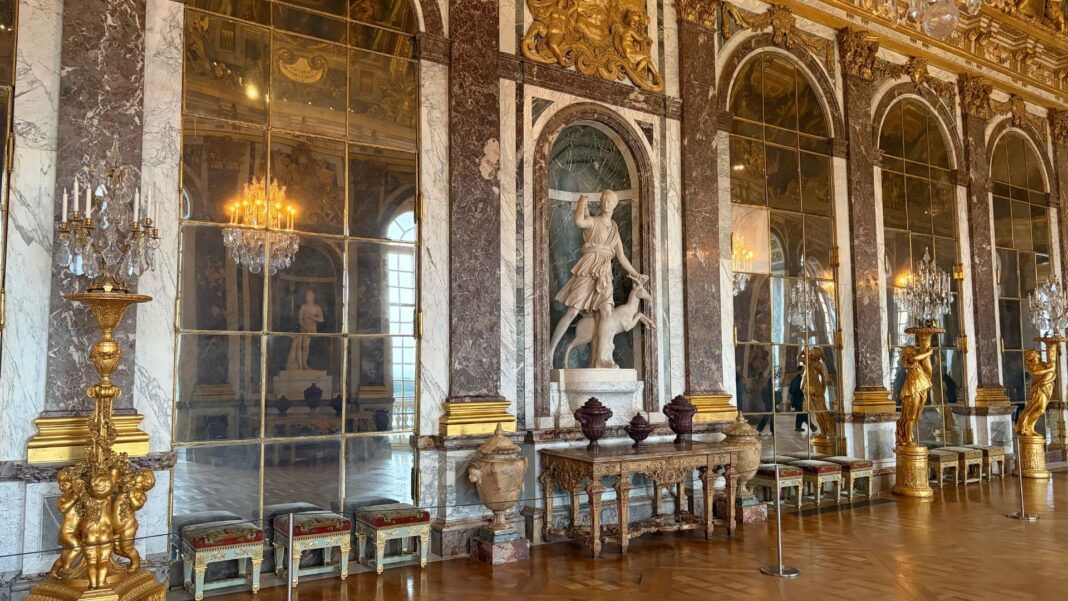
The deception unraveled when the jewelers, expecting payment, approached Marie Antoinette. Horrified, she ordered an investigation. On August 15, 1785, Cardinal de Rohan was arrested in the Hall of Mirrors, moments before officiating Mass. The court was stunned—a prince of the church arrested like a common criminal?
The subsequent trial before the Parlement de Paris was a media spectacle. Rohan, rather than being tried privately, insisted on a public trial, hoping to clear his name. Despite overwhelming evidence of fraud, he was acquitted on May 31, 1786—a verdict that humiliated the monarchy.
The Queen’s Ruin
Though proven innocent, Marie Antoinette’s reputation never recovered. Already criticized for extravagance, she became a symbol of royal greed and corruption. Pamphlets and cartoons depicted her as a manipulative villain, fueling the growing resentment that erupted into the French Revolution.
Jeanne was branded with a “V” for voleuse (thief), publicly whipped, and sentenced to life imprisonment. However, in June 1787, she escaped from prison, disguised as a boy, and fled to London, where she published libelous memoirs falsely implicating Marie Antoinette.
Ultimately, the affair accelerated the monarchy’s collapse. Just a few years later, in 1793, Marie Antoinette would face the guillotine, her downfall intertwined with the echoes of this infamous affair.
Today, as you walk through the gilded halls of Versailles, imagine the whispers of scandal, the fateful meeting in the moonlit gardens, and the moment when a simple diamond necklace helped change the course of history.