If you’ve watched Vikings, especially the season 3 Paris arc—or hacked your way through Assassin’s Creed Valhalla, you’ve seen a stylized version of the Viking attacks on Paris. But the truth behind the 9th-century sieges is more brutal, complex, and influential than anything you’ll find on a screen.
The Viking raids on Paris, first in 845, then again in 885–886, weren’t just moments of medieval chaos. They were turning points in European history that exposed the fractures of a crumbling empire and shaped the future of France.
The First Siege of Paris (845): Ragnar’s Revenge

Prelude to Invasion: A Fractured Frankish Kingdom
By the mid-9th century, Viking raids had become routine along the coasts and rivers of the Frankish Empire. Charlemagne had built defenses in his time, but by the 830s, political fragmentation and civil war left Francia vulnerable. The Vikings knew it.
Paris in 845 was a modest, defensible city centered on the Île de la Cité. But its position on the Seine made it a prime target.
Reginherus on the Seine
On March 28 or 29, 845, 120 longships carrying over 5,000 Viking warriors sailed up the Seine. Their leader was Reginherus, likely the figure behind the saga legend of Ragnar Lodbrok. This wasn’t a random raid. Reginherus had previously been granted land in Flanders by King Charles the Bald, only to fall out of favor. Now he returned with a fleet and a score to settle.
As they advanced, the Vikings sacked Rouen. Charles the Bald scrambled to respond, splitting his forces to guard both riverbanks. The Vikings crushed one division, captured 111 Frankish soldiers, and hanged them on an island in the Seine as a sacrifice to Odin, and a message to the rest.
Easter Sunday: Paris Falls to the Vikings
On Easter Sunday, the Norsemen reached Paris and overwhelmed the city’s defenses. The Franks couldn’t mount an effective resistance. A plague soon struck the Viking camp, possibly dysentery or another waterborne disease. In a rare twist, a Christian captive reportedly advised them to fast, and the disease subsided.
Charles the Bald, dealing with rebellion elsewhere, paid a ransom of 7,000 livres (about 2,570 kg of silver and gold) to get the Vikings to leave. It was the first of many such payments, danegeld, that would burden the Frankish kingdoms for decades.
The Ransom, the Plague, and the Aftermath
The Vikings withdrew, looting monasteries like Saint Bertin on their way out. Reginherus may have seen the massive payout as compensation for the land he’d lost. Critics called Charles cowardly, but in the context of multiple civil wars and limited military power, he saw it as a necessary evil.
That same year, Vikings sacked Hamburg, and King Horik of Denmark, under pressure and frightened by the deadly plague in the Paris campaign—cut support for further raids. According to later sources, he even executed surviving warriors from the expedition and freed Christian captives.
But the signal was clear: Paris was rich, exposed, and worth returning to.
The Second Siege of Paris (885–886): Paris Fights Back
A Fortified City, a Weakened Empire
Forty years later, Paris was tougher. Repeated attacks in the 860s had led to new defenses. Two bridges now spanned the Seine, each with stone towers guarding the approaches. The city had grown in importance, but the Carolingian monarchy was weaker than ever.
The Viking Armada Returns, with Rollo
In late November 885, a massive Viking fleet arrived, contemporary sources claim between 300 and 700 ships, though that’s likely exaggerated. Leaders included Sigfred, Sinric, and the future founder of Normandy, Rollo. They demanded tribute from Emperor Charles the Fat. This time, the answer was no.
Count Odo of Paris assembled about 200 defenders, including Bishop Gozlin and a few nobles. The Franks had numbers against them, but strong fortifications and the river itself on their side.
Siege Engines, Fire Ships, and Twelve Who Died Fighting
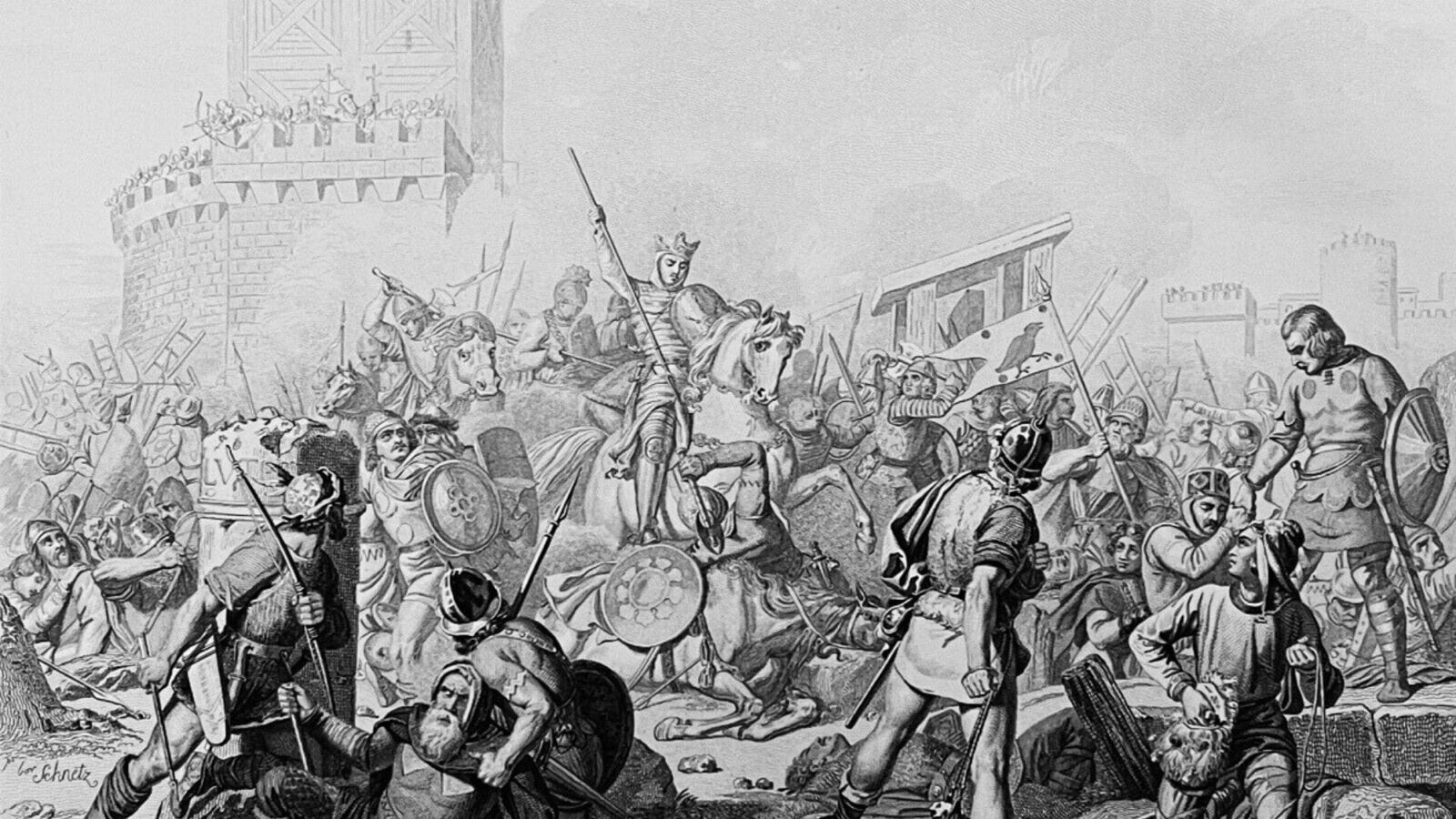
On November 25, the Vikings attacked. They launched siege engines against the northeastern tower but were driven back by boiling pitch, wax, and tenacious resistance. The defenders even built another story onto the tower overnight.
The Vikings tried mining, battering rams, and fire. Bishop Gozlin fought with bow and axe, planting a cross on the ramparts to rally the troops. Their assaults failed.
Stalled, the Vikings dug in, built siege engines, and attempted to destroy the bridges with fire ships and debris. In February 886, one bridge collapsed under the weight of the wreckage and floodwaters, cutting off a tower held by just twelve Frankish soldiers. They fought to the death.
Disease, Desperation, and Defiance
With the bridges down, most of the Viking force moved upriver to raid Burgundy, leaving a detachment behind to maintain the siege. Count Odo slipped through enemy lines to plead for help from Charles the Fat. Reinforcements came, but disease and famine hit both sides.
Bishop Gozlin died in June. Odo returned and fought his way back into Paris. That summer, the Vikings tried a final assault. They failed.
Charles the Fat Buys Time, Odo Wins a Crown
In October, Charles the Fat finally arrived. The defenders expected a decisive counterattack. Instead, Charles struck a deal: he allowed the Vikings to continue up the Seine to plunder rebellious Burgundy, and paid them 700 livres of silver.
Parisians were outraged. Odo, who had risked everything to hold the city, became a hero. Charles died shortly after, and in 888, Odo was elected king, the first non-Carolingian ruler of West Francia.
From Siege to Dynasty: Why These Battles Mattered
The second siege didn’t just protect Paris. It shifted the balance of power in the region. Local leaders like Odo began to eclipse distant royal authority. The rise of the Robertians, Odo’s family, set the stage for the Capetian dynasty, which would rule France for centuries.
The Viking threat hadn’t just terrorized the Franks. It forced them to adapt, decentralize, and rebuild. Paris became more than a city, it became a symbol of resistance.