On an autumn afternoon in 1895, Paris learned, violently, that trains do not forgive small mistakes.
At four o’clock on October 22, the express train no. 56 from Granville failed to stop at the Gare de l’Ouest, the station we now know as Gare Montparnasse. Instead, it burst through the end of the line, smashed through the station’s façade, and plunged nose-first onto the Place de Rennes below. One woman was killed. A locomotive hung improbably in midair. And a single photograph fixed the moment forever in the global imagination.
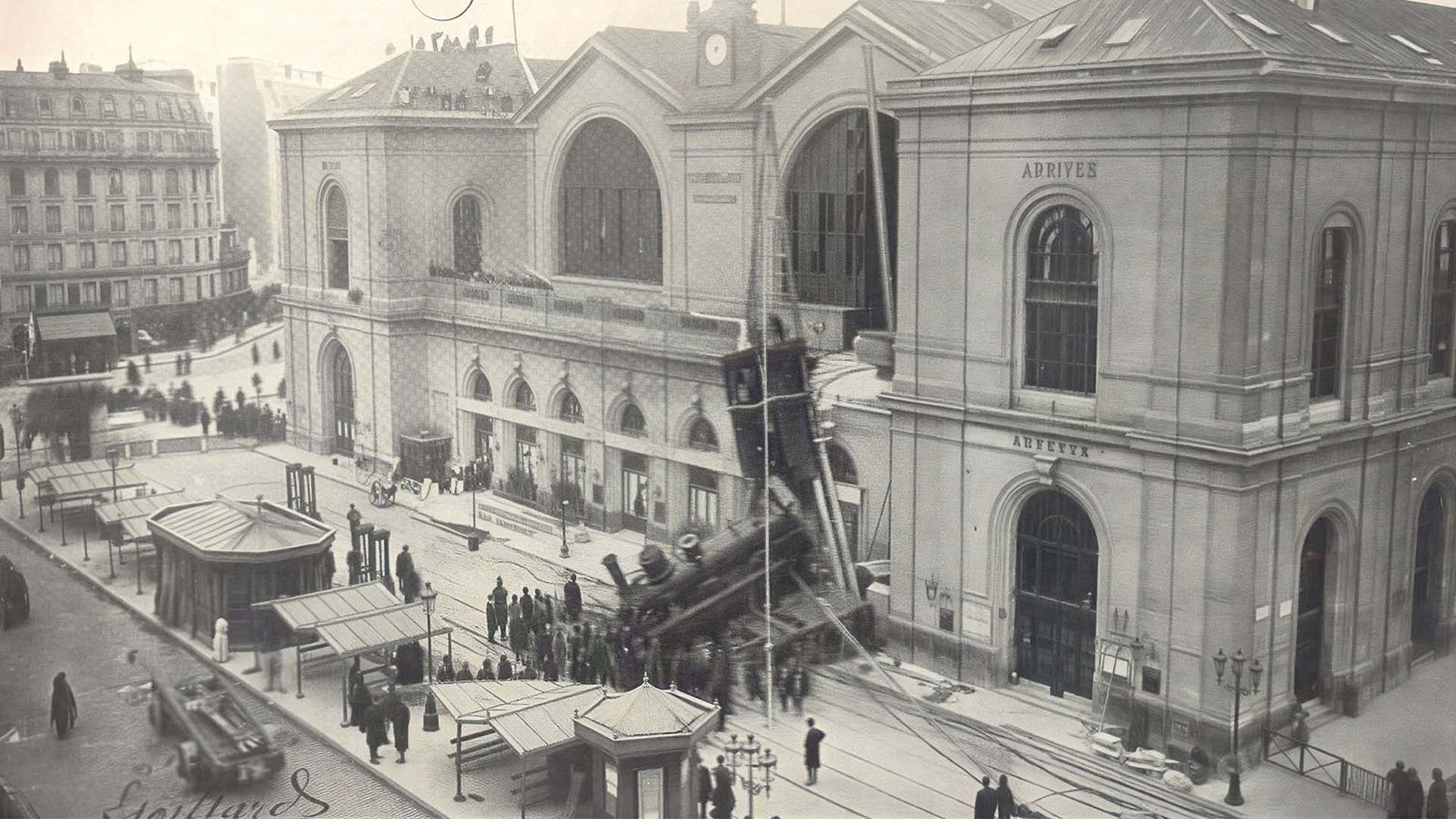
A station built on a ledge
In 1895, the Gare de l’Ouest sat at the edge of Paris, straddling what are now the 14th and 15th arrondissements. Built by the Compagnie des chemins de fer de l’Ouest, it served both the Ouest network, toward Versailles-Rive-Gauche, Le Mans, and Granville, and the State network, with lines reaching as far as Nantes, Saumur, Niort, and Bordeaux.
Trains approached the station through the suburbs of Vanves and Malakoff, crossing city streets at grade before rolling over a viaduct spanning the avenue du Maine and boulevard Edgar-Quinet. Inside, six dead-end tracks terminated in a two-bay hall. Crucially, these tracks sat nine meters above street level, directly above the intersection of the rue de Rennes and the boulevard du Montparnasse. It was a station quite literally perched over the city.
The train from Granville
Train no. 56 left Granville at 8:45 a.m., scheduled to arrive in Paris at 3:55 p.m. on track 6. At its head was locomotive no. 721, a type 120 engine, driven by Guillaume Pellerin, with Victor Garnier as fireman.
Behind the tender came two baggage vans, a postal wagon, and ten passenger cars. Among them was salon car no. 1506, occupied by the family of Albert Christophle, governor of the Crédit Foncier. The last vehicle was another baggage van. The train was full.
By the time it reached Versailles-Chantiers, it was running seven minutes late. Two minutes were recovered on the approach to Montparnasse, but time would soon prove irrelevant.
Sixty seconds of chaos
As the train entered the station’s outer approaches, something went wrong. The crew later said the Westinghouse air brake had failed. It had worked moments earlier, slowing the train over the switches near Ouest-Ceinture station and at the level crossing on the rue de la Procession. But at the rue du Château, just a few hundred meters from the platforms, it no longer responded.
The train was still moving at 65 km/h. Pellerin reversed the steam, sanded the rails, and whistled urgently for the conductors to apply emergency braking. The chief conductor tightened the hand brake on his van but failed to open the emergency air valve. The reversal of motion came too late, only a few dozen meters from the buffer stop.
Under the great glass hall, the express thundered in at roughly 40 km/h. Passengers panicked. The locomotive shattered the wooden buffer stop, smashed through the concrete end-of-track platform, punched through the façade wall and its glass partition, crossed the narrow terrace above the Place de Rennes, and burst through the stone balcony.
Then gravity took over.
The locomotive tipped forward into empty space. Its front end buried itself in the ground at a tramway stop below, destroying a newspaper kiosk. The tender followed but remained suspended, its coupling miraculously intact, hanging from the first baggage van, which stayed on the tracks inside the station. Every electric clock in the building stopped at 4:00 p.m.

One life lost
The accident caused a single death, but it was a brutal one. Marie-Augustine Haguillard, 37, a newspaper seller and mother of two children aged five and nine, was standing at the tramway stop. She was killed by falling masonry from the façade and by the locomotive’s ash pan.
By chance, the shelter itself was empty of passengers, and the crowded Montparnasse–Étoile tram had already been pulled away by its frightened horses. Another kiosk owner, Madame Pelletier, whose stand stood directly in line with track 6, fled just in time.
Pellerin and Garnier were thrown clear when the locomotive hit the buffer stop, Pellerin into the space between tracks, Garnier onto the platform. Both suffered only minor injuries.
Inside the station, the worst was avoided. The sudden deceleration could have telescoped the cars, but they remained on the rails. A ruptured air line triggered braking, and the hand brake on the rear van held firm. Passengers suffered only minor bruises. Among them were three deputies from the Orne; Félix de Lévis-Mirepoix, Albert Christophle, and Jules Gévelot, who had boarded at Briouze.

Crowds, cameras, and curiosity
The spectacle drew Paris almost instantly. By 5:30 p.m., the minister of public works, Dupuy-Dutemps, and the prefect of police, Louis Lépine, were on site. Twenty mounted municipal guards and a hundred on foot struggled to contain the crowds.
Many simply bought the cheapest tickets available, not to travel, but to access the platforms and see the wreck. The station continued operating. Newspapers the next day ran playful, even mocking headlines. For five days, the popular press treated the recovery of the locomotive like a serialized drama. The neighborhood thrived on the attention; transport companies and local merchants did brisk business.
The story crossed the Atlantic. American newspapers ran it too.
Lifting fifty tons of steel
The tender was quickly secured to prevent it from falling. The locomotive itself, weighing around fifty tons, posed a serious challenge. Engineers decided to slide it down an improvised staircase of heavy timbers. Two attempts; first with fifty men, then with horses, failed.
On October 25, the operation succeeded using a massive winch and powerful jacks. Remarkably intact, aside from a destroyed small piston and some warped parts, the locomotive was hoisted onto a wheeled cradle, pulled by twenty-five horses, and taken to the Cail works at Javel. There it was examined by Michel Lévy, an engineer from the Corps des Mines appointed as expert by the investigating judge.
The tender was then hauled back into the station and returned to the rails with the combined effort of three lifting cranes and a locomotive pulling from the platforms. Pedestrian and tram traffic on the square resumed on October 28.
Fault, fatigue, and the law
Civilly, the railway company accepted responsibility for Marie-Augustine Haguillard’s death. It paid a modest indemnity to her companion and undertook to educate her two children, promising them future employment within the company.
Criminal responsibility proved more complex. Judge Bertulus opened an inquiry for homicide and injury by negligence. Tests on the train’s air brake, conducted after it was moved to a siding, showed it worked perfectly. Examination of the locomotive revealed no clear defect.
In the end, the brake itself mattered less than procedure. Regulations required reduced speed on approach to the station and explicitly forbade the use of the air brake at Montparnasse and the Bastille, both built on elevated platforms. Conductors, meanwhile, were instructed to open the Westinghouse emergency valve, not rely on the hand brake, when signaled.
Experts disagreed in court. One inspector argued the brake had functioned but could not stop a train arriving too fast on rain-slick rails. Another insisted it had failed. Lévy, the court-appointed expert, concluded that the brake might indeed have malfunctioned, but that the train was unquestionably traveling too fast, 60 to 65 km/h, within meters of the station. He emphasized Pellerin’s excellent service record and the fact that he had been on duty for six and three-quarter hours straight. The chief conductor, Albert Mariette, he said, was distracted by administrative duties customary at arrival, at a time when manual backup procedures for brake failures had fallen out of habit.
On March 31, 1896, the court found “very mitigating circumstances.” Pellerin was sentenced to two months in prison, suspended, and fined 50 francs. Mariette received a symbolic suspended fine of 25 francs.
An image that would not fade
The physical damage was repaired. The schedules resumed. But the image of that locomotive, frozen mid-fall, improbably balanced above a Paris street, never left.
From the very beginning, the accident seemed made for memory. The photograph taken in the aftermath, steel frozen midair, stone shattered, a Parisian street abruptly transformed into a railway abyss, circulated far beyond France. It stripped the age of steam of its optimism and left behind something stranger: awe mixed with unease.
That single image became a point of reference for artists across generations. In 1937, Man Ray drew a train falling from the sky for Rêve, published in Les Mains libres, turning mechanical failure into surreal inevitability. Decades later, Jacques Tardi drew directly from the Montparnasse disaster in Momies en folie, one of the albums in Les Aventures extraordinaires d’Adèle Blanc-Sec, embedding the crash into his vision of a haunted, fin-de-siècle Paris.

In popular culture, the accident reached a new audience in 2011 with Martin Scorsese’s film Hugo. Its spectacular train wreck, unfolding inside a Paris station, is unmistakably modeled on Montparnasse, translating a 19th-century catastrophe into cinematic myth. For many viewers, it was their first encounter with an event that had once stopped Paris in its tracks.
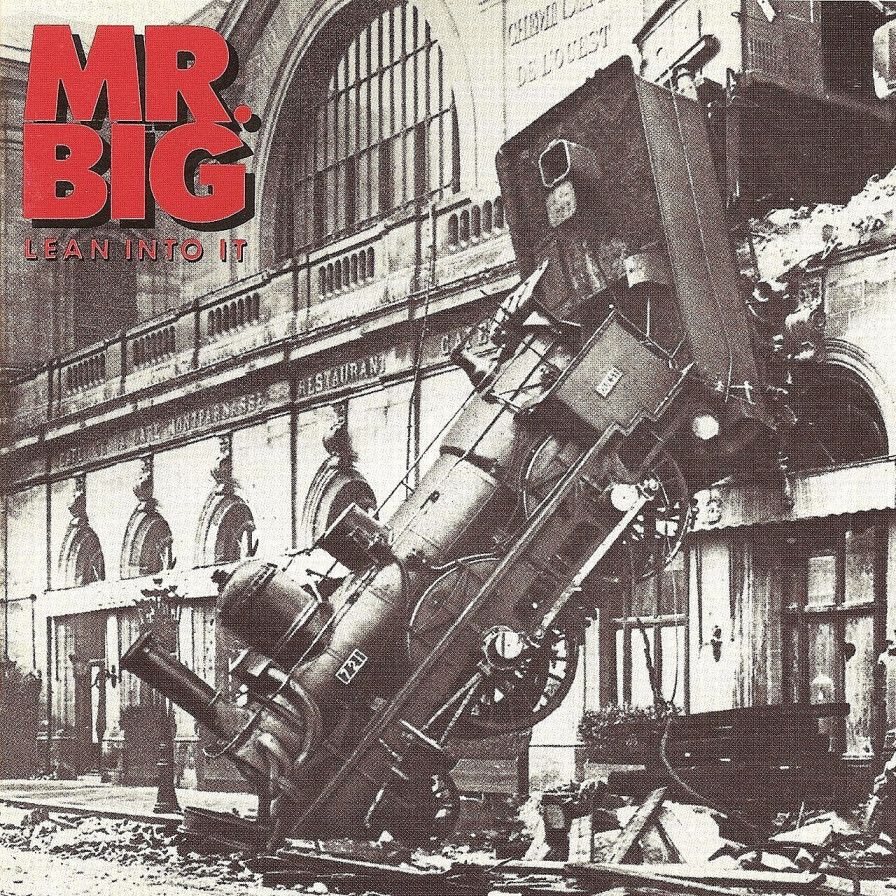
Music, too, borrowed the image. In 1991, the photograph of the fallen locomotive became the cover of Lean Into It by the American rock band Mr. Big, proof that a Paris railway accident from 1895 could still speak to the modern imagination.

Visitors who want to see how the accident was recorded at the time can find an original image at the Musée Carnavalet. The museum holds an 1895 albumen print by the Neurdein Frères, one of the photographic studios that documented the crash in its aftermath, now preserved in the museum’s collections devoted to the history of Paris.
Gare Montparnasse now functions as one of Paris’s busiest transport hubs, efficient and unremarkable. Little in the building recalls the events of 1895. What endures is the photograph, taken seconds after the impact, recording the instant when modern rail travel failed in full public view, and when a city street briefly became the final stop of an express train.