The royal squares in Paris are among the city’s most distinguished landmarks, embodying centuries of history, architectural grandeur, and cultural significance. These meticulously designed public spaces have served as the backdrop for royal ceremonies, historical events, and social gatherings, each with its own compelling narrative. Visitors to Paris are drawn to these squares not only for their aesthetic appeal but also for the deep historical resonance they carry.
From the early days of French monarchy to the modern era, each royal square tells a unique story of power, artistry, and urban planning. Their symmetrical layouts, grand facades, and iconic statues stand as testaments to France’s enduring architectural legacy.
1. Place des Vosges: The Birth of Parisian Squares

As the oldest planned square in Paris, Place des Vosges is a paragon of early French urban design. Originally named Place Royale, it was commissioned by King Henry IV and completed between 1605 and 1612. Its harmonious red-brick facades, punctuated by stone quoins, exude an air of refined elegance.

Nestled in the heart of the Marais district, Place des Vosges was envisioned as a space for noble residences, offering an ideal setting for aristocratic life. The royal square was inaugurated in 1612 with a grand equestrian festival in honor of the marriage of Louis XIII and Anne of Austria.

Today, Place des Vosges retains its historic charm. Visitors can stroll beneath its vaulted arcades, admire the well-manicured central garden, and explore cultural landmarks such as the Maison de Victor Hugo, where the famed writer once resided.
2. Place Dauphine: A Hidden Haven on Île de la Cité

Tucked away on the western tip of Île de la Cité, Place Dauphine is the most intimate royal square in Paris. Commissioned by Henry IV in 1607, it was dedicated to his son, the future Louis XIII.

Unlike its grander counterparts, Place Dauphine is characterized by its triangular layout and discreet charm. The square is framed by elegant 17th-century buildings, many of which have preserved their original architectural features. Tree-lined walkways and cozy cafés create a serene ambiance, making it a favorite retreat for artists, writers, and flâneurs seeking respite from the city’s hustle and bustle.

Despite its peaceful atmosphere, Place Dauphine has witnessed centuries of Parisian history. From royal gatherings to revolutionary fervor, this square remains a testament to the city’s evolving narrative. Visitors can enjoy a leisurely coffee at one of the local bistros, taking in the quiet beauty of one of Paris’s best-kept secrets.
3. Place Vendôme: The Epitome of Luxury and Prestige

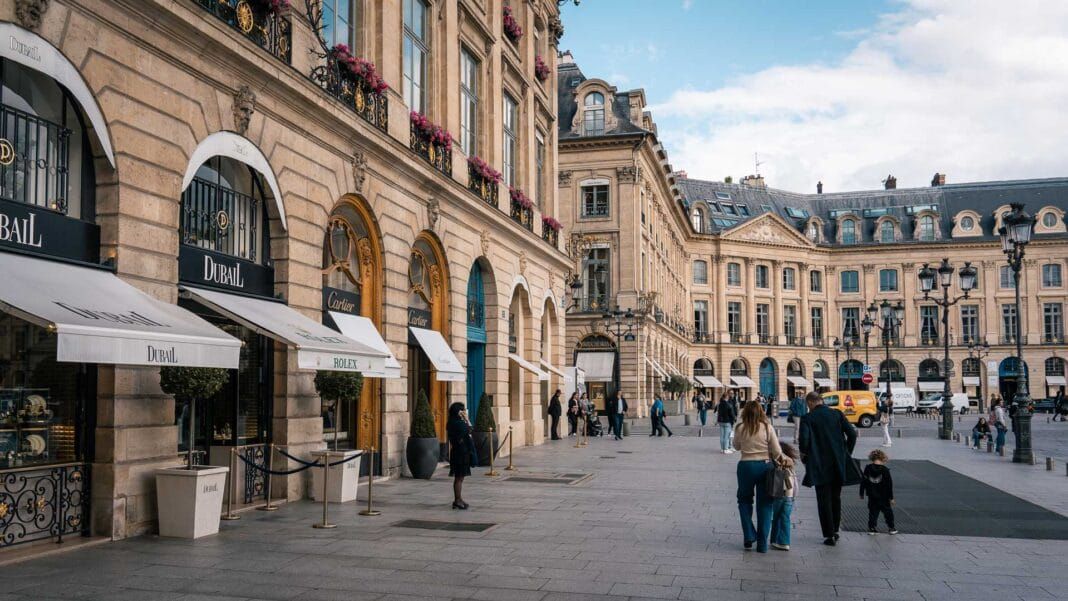
Commissioned by Louis XIV in the late 17th century, Place Vendôme stands as a symbol of Parisian opulence and refinement. Designed by architect Jules Hardouin-Mansart, the royal square was originally intended to house royal institutions and accommodate grandiose celebrations.

At its center rises the imposing Vendôme Column, a 44-meter-high monument erected by Napoleon I to commemorate his military triumphs. Constructed from the bronze of captured cannons, the column is crowned with a statue of the emperor himself, reinforcing its historical significance.

Surrounding the square are some of the world’s most prestigious establishments, including luxury jewelry houses, haute couture boutiques, and the iconic Ritz Paris. A stroll through Place Vendôme offers a glimpse into the grandeur of French aristocracy and the enduring legacy of Paris as a capital of elegance and sophistication.
4. Place des Victoires: A Monument to the Sun King

Conceived as a tribute to Louis XIV’s military conquests, Place des Victoires is one of Paris’s most distinguished circular squares. Designed by architect Jules Hardouin-Mansart in 1686, it is centered around an equestrian statue of the Sun King, a powerful symbol of his reign.

The royal square’s architectural unity, featuring uniform façades with arched ground floors and classical pilasters, creates a sense of symmetry and grandeur. Despite its regal origins, Place des Victoires has evolved into a quiet, elegant enclave, favored by art galleries and high-end boutiques.

Situated near the Palais-Royal, this historic square is a lesser-known gem, offering visitors a chance to appreciate Parisian elegance away from the bustling tourist crowds. The combination of royal heritage and contemporary charm makes Place des Victoires a must-visit for those seeking a deeper understanding of Paris’s aristocratic past.
5. Place de la Concorde: Witness to History

As the largest and most historically significant square in Paris, Place de la Concorde is an open-air museum of French history. Originally designed in 1755 by architect Ange-Jacques Gabriel, it was initially named Place Louis XV, featuring an equestrian statue of the king.
During the French Revolution, the square was renamed Place de la Révolution and became infamous as the site of the guillotine, where King Louis XVI, Queen Marie Antoinette, and many others met their fate. It was later rechristened Place de la Concorde to symbolize national reconciliation.

Dominating the square is the Luxor Obelisk, a 3,300-year-old monument gifted by Egypt in the 19th century. Flanking the obelisk are two ornate fountains, inspired by the grand designs of Rome, further enhancing the square’s majestic appeal.

Situated between the Tuileries Garden and the Champs-Élysées, Place de la Concorde remains a focal point of Parisian life. Whether admiring its historical significance, capturing its breathtaking views, or simply passing through on a scenic walk, visitors are inevitably drawn to its grandeur and storied past.
And that’s it folks! So, what’s your favorite royal squares in Paris?