


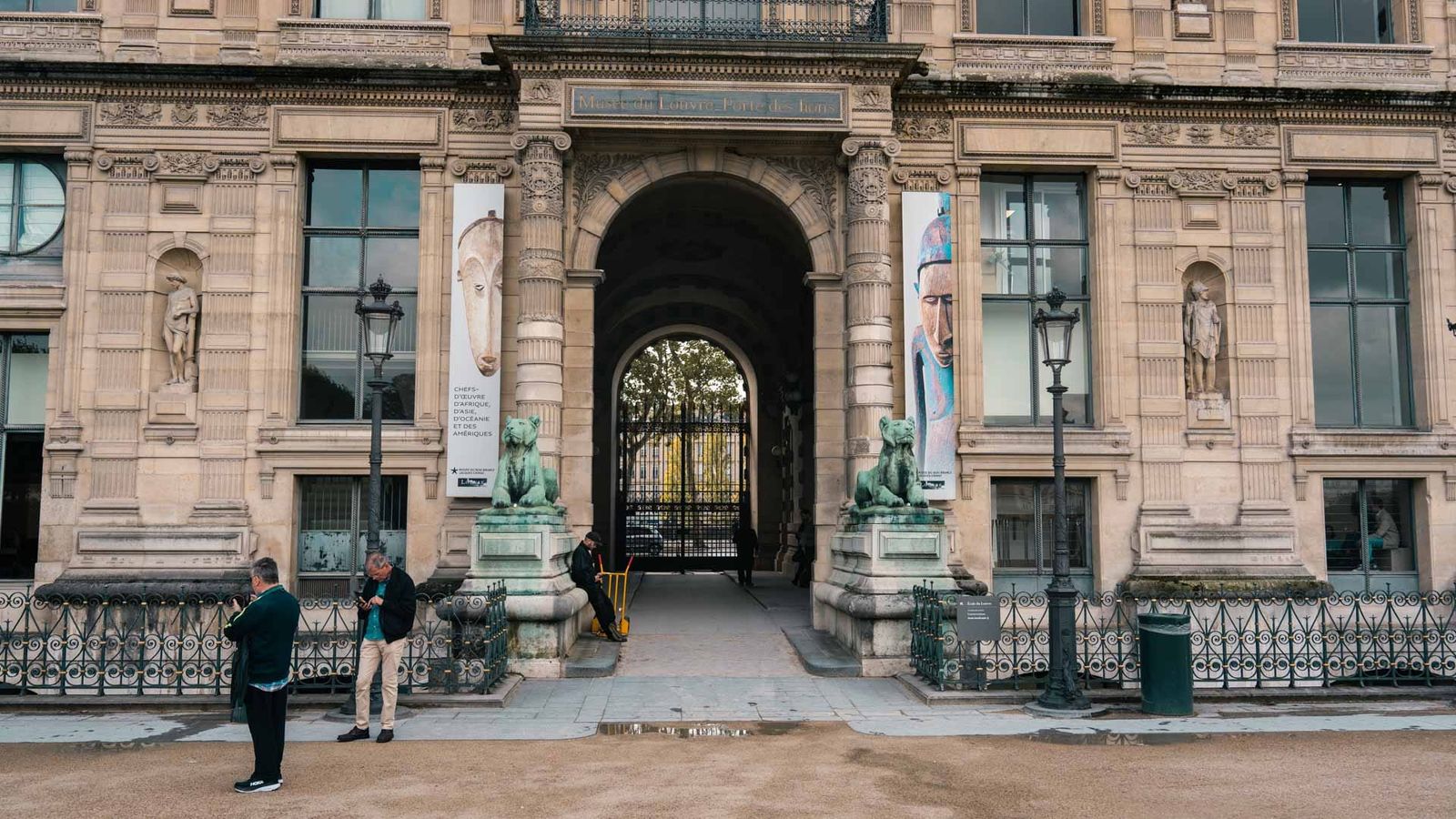
Nestled along the Quai François Mitterrand on an elegant wing of the Louvre, La Porte des Lions is a striking entrance that connects visitors from the banks of the Seine to the tranquil Place du Carrousel.
The entryway, adorned with bronze sculptures of lions and lionesses, reveals a rich history of art, architecture, and powerful symbolism.
Architectural Transformation and Artistic Legacy
Originally crafted by Jacques Androuet du Cerceau in 1595, the wing hosting La Porte des Lions underwent extensive reconstruction between 1861 and 1869 under architect Hector Lefuel. This renovation, aimed at preserving the Louvre’s majestic aesthetic, harmonized the historic structure with the artistic vision of the era, resulting in a unique blend of Renaissance and 19th-century design.
Lefuel’s modifications provided a harmonious passage from the riverfront to the Carrousel, creating a seamless transition between urban Paris and the Louvre’s quiet gardens.
A Masterpiece of Sculptural Art by Renowned Artists
The entrance’s symbolic decorations are no less significant than its architectural roots. Above the doorway lies the Fronton of Théodore Gruyère, crafted in 1864 to replicate the Barbet de Jouy model by Duban and sculptor Jacquot.
Below, intricate trophies, decorative columns, and playful friezes featuring children, designed by Morand, add rich detailing to this gateway.
Barye’s Bronze Lions: Guardians of the South Entrance
Flanking the southern side of the doorway are two impressive bronze lions by Antoine-Louis Barye. Originally cast in 1847, one of these lions was initially displayed in the Tuileries Garden before being installed permanently at La Porte des Lions.
A second lion, cast in perfect symmetry, joined the original to create a powerful and protective duo at the entrance in November 1867. These seated lions, with their noble posture and careful detailing, have since become emblems of the Louvre’s grandeur and artistic heritage.
Caïn’s Sahara Lionesses: Symbols of Strength at the North Entrance
On the northern side of the doorway, Auguste Caïn’s Sahara lionesses bring a unique elegance and exoticism to the Louvre.
These statues, positioned to face the Carrousel Garden, create an engaging contrast with Barye’s lions and symbolize the expansive reach of French art, incorporating inspirations from distant lands into the very heart of Paris.
A Unique Connection: From the Seine to the Carrousel Garden
La Porte des Lions holds a practical and symbolic role within the Louvre’s layout. Beyond its sculptural and architectural beauty, it serves as a quiet passage linking the Quai François Mitterrand with the Carrousel Garden.
This pathway, watched over by these four majestic creatures, is a quiet escape from the bustling museum, allowing visitors to transition from the historic stone facades to the lush greenery of the Louvre’s gardens.