


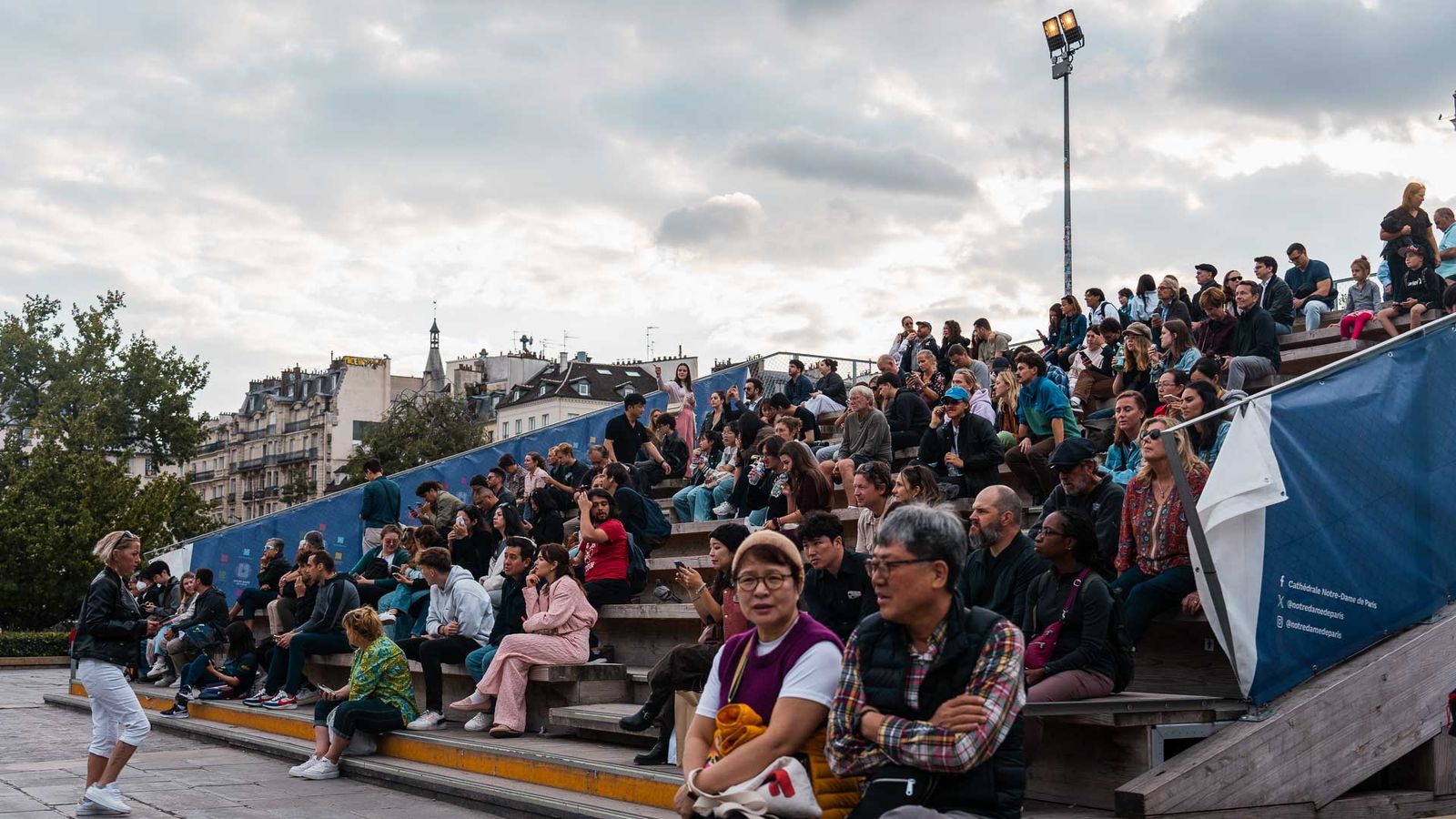
The Parvis Notre-Dame – Place Jean-Paul II is more than just the space in front of the world-renowned Notre-Dame Cathedral; it is a vibrant forecourt steeped in history and spirituality.
Located on the Île de la Cité, this iconic Parisian square connects visitors to the city’s heart, offering a unique blend of architectural marvels, historical monuments, and quiet areas for reflection. The square was renamed in 2006 to honor Pope John Paul II. Throughout centuries, the Parvis has been reshaped and redeveloped, adapting to the changing needs of Paris while preserving its spiritual significance.
A Forecourt of Historical Evolution
The Parvis Notre-Dame has transformed since its origins in the 12th century when it was first developed in front of the early Saint-Étienne Cathedral. Subsequent expansions under Baron Haussmann in the 1860s shaped the modern square, which now covers an area of 1,200 m². Standing in the center, visitors are surrounded by architectural markers from different periods, including remnants of pre-Haussmannian Paris outlined in white stone.
The Statue of Charlemagne
On the south side of the Parvis, adjacent to the Seine, stands an imposing bronze statue of Charlemagne on horseback, crafted by sculptor Louis Rochet and first unveiled at the 1878 Exposition Universelle. Accompanied by his loyal knights Olivier and Roland, Charlemagne symbolizes Paris’ historical and cultural roots, connecting the forecourt to the grand narrative of French history.
Unearthing the Past: The Archeological Crypt
Directly beneath the square lies the Archaeological Crypt, a remarkable underground site preserving Roman ruins and relics unearthed during excavations in the 1960s and 1970s. The crypt showcases vestiges from ancient Paris, known then as Lutetia, with fragments of walls, roads, and artifacts dating back to antiquity. This hidden museum beneath the Parvis provides a tangible connection to Paris’ earliest days, juxtaposing the grandeur of the Gothic Notre-Dame with the quieter layers of its past.
Points of Historical Interest Engraved in Stone
Several engravings around the square commemorate the earlier structures that stood here, including Saint-Étienne Basilica and the Hotel-Dieu, Paris’ oldest hospital. Near Notre-Dame’s steps lies a bronze plaque marking the Zero Point of French Roads, symbolizing Paris’ position as the center of French geography and culture. This small but significant marker underscores Paris’ role in connecting France, both physically and symbolically.